Energy Spikes, Yield Pressures, and the FOMC Shadow
By Fauzia Timberlake, personal coach for trading options
September 14, 2026
Macro Overview of Markets
Major U.S. stock indices faced a punishing, volatile week marked by geopolitical shocks and persistent inflation pressures. Returning from the Labor Day holiday, markets absorbed negative catalysts including supply disruptions, retaliatory trade measures, and sticky August consumer price data that all but cemented an impending Federal Reserve rate hike. Although a late-week relief bounce on Friday helped trim losses, equities finished the week lower across the board under the weight of higher borrowing costs and surging energy expenses.
Treasury yields faced heavy upward pressure throughout the week, pushing toward multi-decade highs. The 10-year yield hovered near critical psychological boundaries close to 4.96%, driven by fears that stubborn inflation and aggressive central bank monetary tightening will keep real interest rates elevated, reducing the relative attractiveness of equities.
Precious metals experienced robust safe-haven demand mid-week as geopolitical tensions in energy corridors escalated. Although gold eased slightly to close out the week near $4,389.10/oz following a late pullback in crude and a minor bounce in risk sentiment, it retained solid gains on a weekly basis as institutional investors sought hedges against macroeconomic and sovereign debt volatility.
Crude oil underwent a dramatic surge, breaking past triple digits mid-week to trade above $100–$102/barrel (with WTI hitting highs near $102.48). Prices spiked following regional supply disruptions and security flashpoints in key shipping channels like the Red Sea and Strait of Hormuz, injecting immediate cost-push inflation fears back into the global economy before easing slightly into Friday's close.
Cryptocurrencies displayed relative resilience amid macro cross-currents. Bitcoin consolidated tightly around the $77,400–$78,500 corridor, weathering the broader risk-off equity sell-off early in the week and acting as a choppy alternative liquidity vehicle while traditional markets digested central bank and inflation trajectories.
In summary, returning from the post-Labor Day holiday, financial markets navigated a volatile, headline-driven week characterized by a sharp resurgence in energy-cost pressures, surging Treasury yields, and an escalating probability of a Federal Reserve rate hike. Equities endured a four-session losing streak mid-week as WTI crude briefly spiked past triple digits on geopolitical transit bottlenecks and wholesale inflation numbers printed hotter than anticipated. Although a strong, broad-based relief rally on Friday clawed back significant ground—bolstered by in-line consumer price index data and an easing in oil—major U.S. benchmarks still finished the week in negative territory overall.
Strategy Corner
Based on this week's market movements, here are some trading ideas and option strategies for the readers' consideration. The positions can be scaled bigger (or smaller) to suit individual account size.
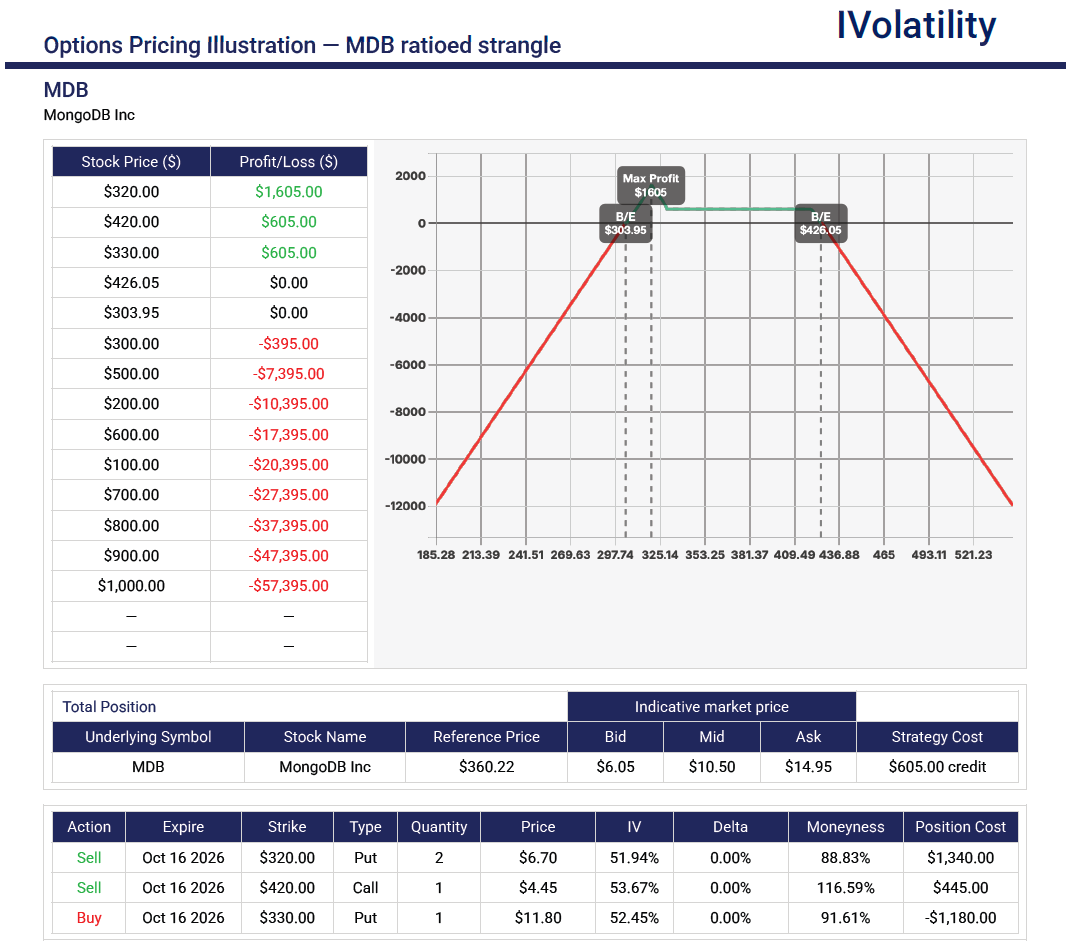
MDB (closed at 361.82 on Friday, Sep 11th)
MDB recently experienced a sharp, post-earnings digestion phase, pulling back aggressively from the $470+ level down into the mid-$360s following its Q2 report.
Assuming what is widely known as a "puke and stabilize" move, a trader could open a neutral position in the October expiration with a strangle but add in a long put spread to capture some downside if presented (called a ratioed strangle).
- Structure: In the Oct16 expiration, sell the 320/420 strangle and use part of the credit collected to buy 330/320 long put spread as a sort of "insurance" against further downside.
- Collect a credit for the entire ratioed strangle
- Upside breakeven around 420 PLUS credit collected
- Downside breakeven around 310 LESS the credit collected
- Maximum potential value of an additional $1000 if MDB pins 330 at expiration
WDC (closed at 447.18 on Friday, Sep 11th)
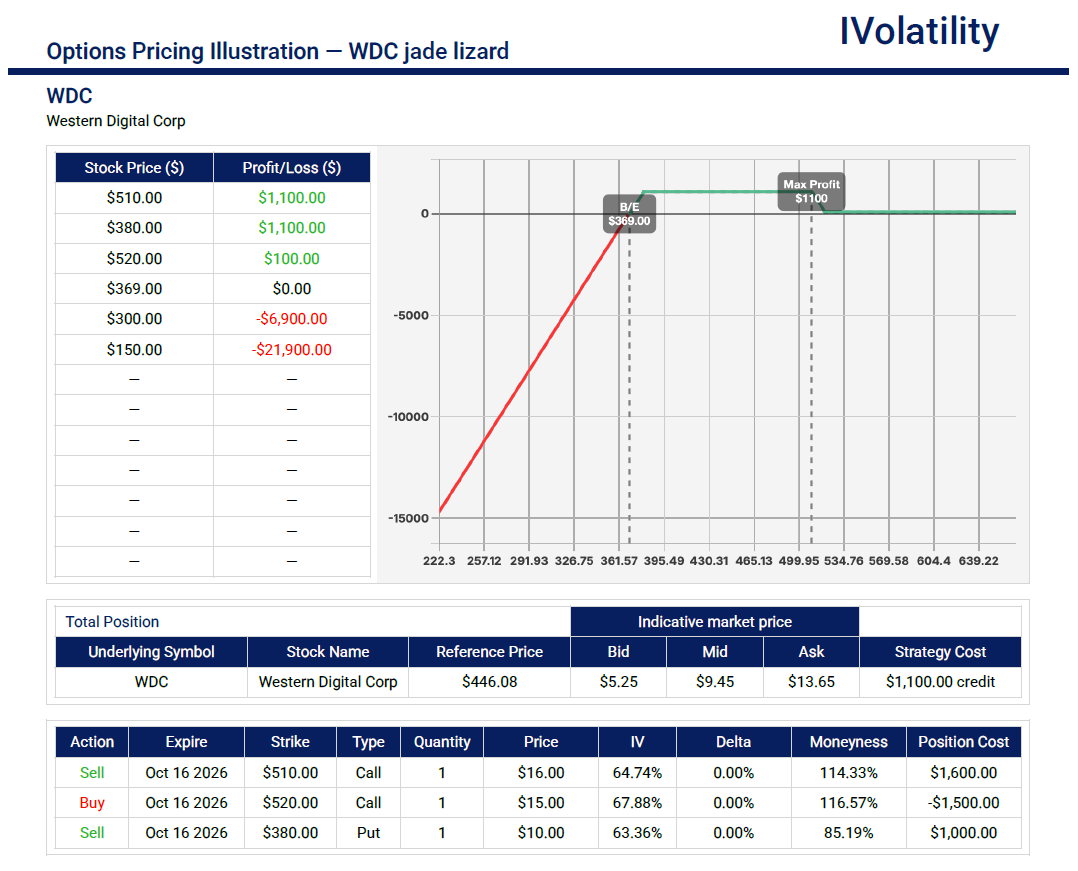
WDC has experienced a high-beta ride over the past year [cite: 1.1.3] and recently retreated from September peaks near $482 back down toward the mid-$440s. If a trader would like to open a neutral-bullish position at this level, a jade lizard could be deployed.
- Structure: In the Oct16 expiration, sell the 380put and simultaneously sell the 500/510 call spread.
- Collect a total credit that covers the $10 wide call spread
- Downside breakeven around 320 LESS the credit collected
- No risk to the upside
Movement of the Major Market Indices:
| INDEX | UP | DOWN |
| SPY | -0.79% | |
| QQQ | -0.93% | |
| IWM | -2.21% | |
| DIA | -0.84% | |
| GLD | -1.65% | |
| BTC/USD | -3.26% | |
| 10-year yield | 3.97% | |
| Crude Oil | 7.83% | |
| VIX | 1.80% |
Movement of the Major Market Sectors:
| SECTOR | UP | DOWN |
| TECH (XLK) | -0.51% | |
| FINANCIALS (XL) | -0.80% | |
| INDUSTRIALS (XLI) | -1.58% | |
| ENERGY XLE | 0.48% | |
| HEALTHCARE (XLV) | -1.74% | |
| UTILITIES (XLU) | -1.53% | |
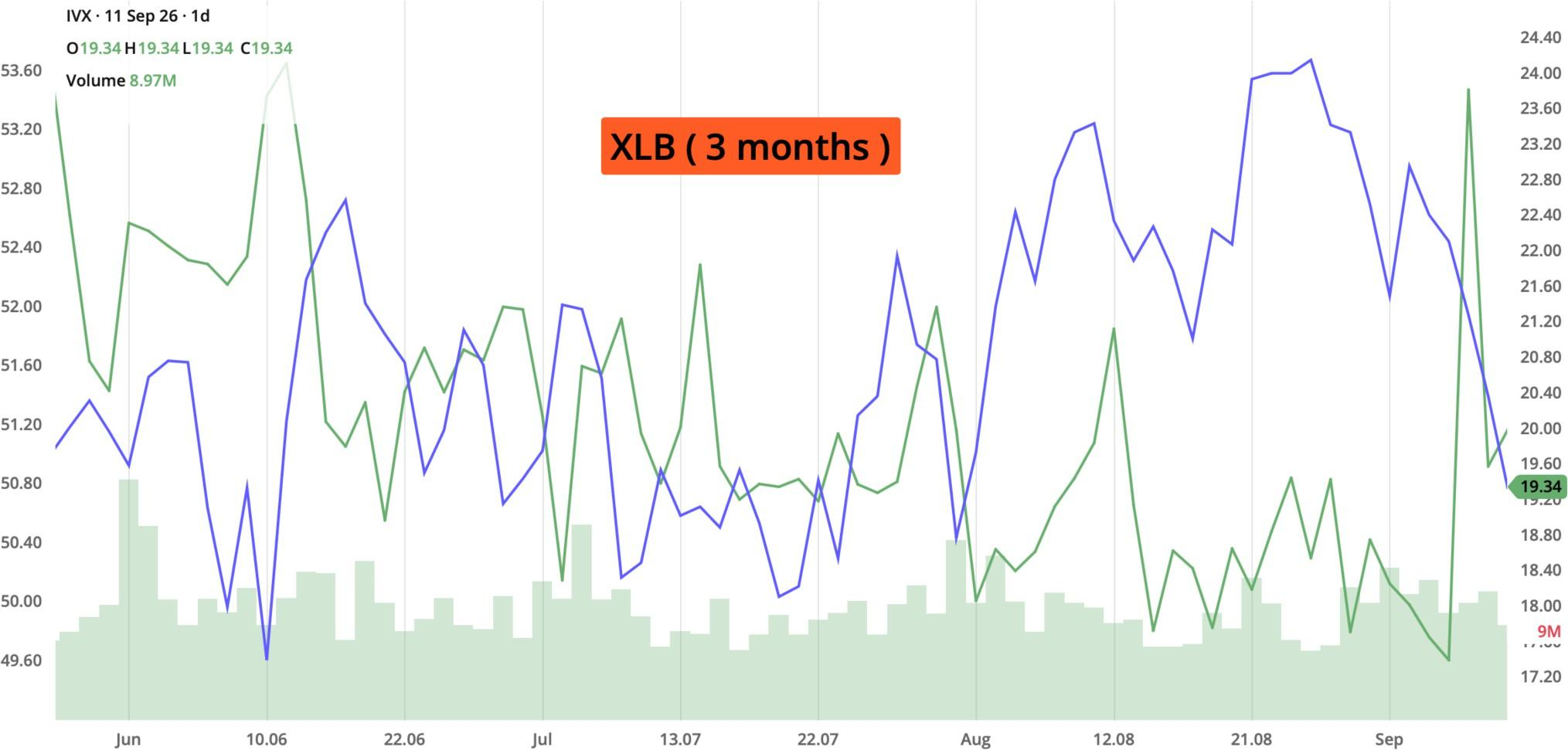
| MATERIALS (XLB) | -2.69% | |
| REAL ESTATE (XLRE) | -0.57% | |
| CONSUMER STAPLES (XLP) | -1.07% | |
| CONSUMER DISCRETIONARY (XLY) | -1.32% |
Notable Gainers Week of Sep 7th – Sep 11th
Hewlett Packard Enterprise Company (HPE): Climbed 12.4% as surging optimism surrounding artificial intelligence systems, enterprise server demand, and robust cloud infrastructure spending drove heavy institutional accumulation.
Lumentum Holdings Inc. (LITE): Advanced roughly 9.0% to lead major optical networking components names as market participants rotated into high-bandwidth infrastructure plays tied to next-generation data center expansions.
TKO Group Holdings, Inc. (TKO): Gained 5.9% as strong institutional support for scarce live entertainment properties and valuable global media rights propelled the stock higher amid broader market choppiness.
Notable Losers Week of Sep 7th – Sep 11th
The week's negative price action featured selective profit-taking and defensive sector rotation, driven by several key underlying catalysts:
- Rising margin pressures and conservative forward guidance updates triggered sharp downward revisions across select healthcare and medical device providers.
- Macroeconomic headwinds and cautious consumer spending forecasts sparked localized selling pressure among cyclical basic materials and specialty manufacturing stocks.
- Priced-to-perfection valuations in select high-flying technology segments faced institutional selling as capital rotated toward more defensive, cash-generative value sectors.
The Cooper Companies, Inc. (COO): Declined 7.4% following a cautious margin outlook and softer-than-expected segment metrics that prompted near-term institutional profit-taking.
Novartis AG (NVS): Slipped 5.2% as sector-wide rotation away from defensive pharmaceuticals and recent pipeline timing updates weighed on investor sentiment.
Tandem Diabetes Care, Inc. (TMDX / TNDM): Dropped 6.8% amid heightened competitive pressures and broader weakness across specialized medical technology equities.
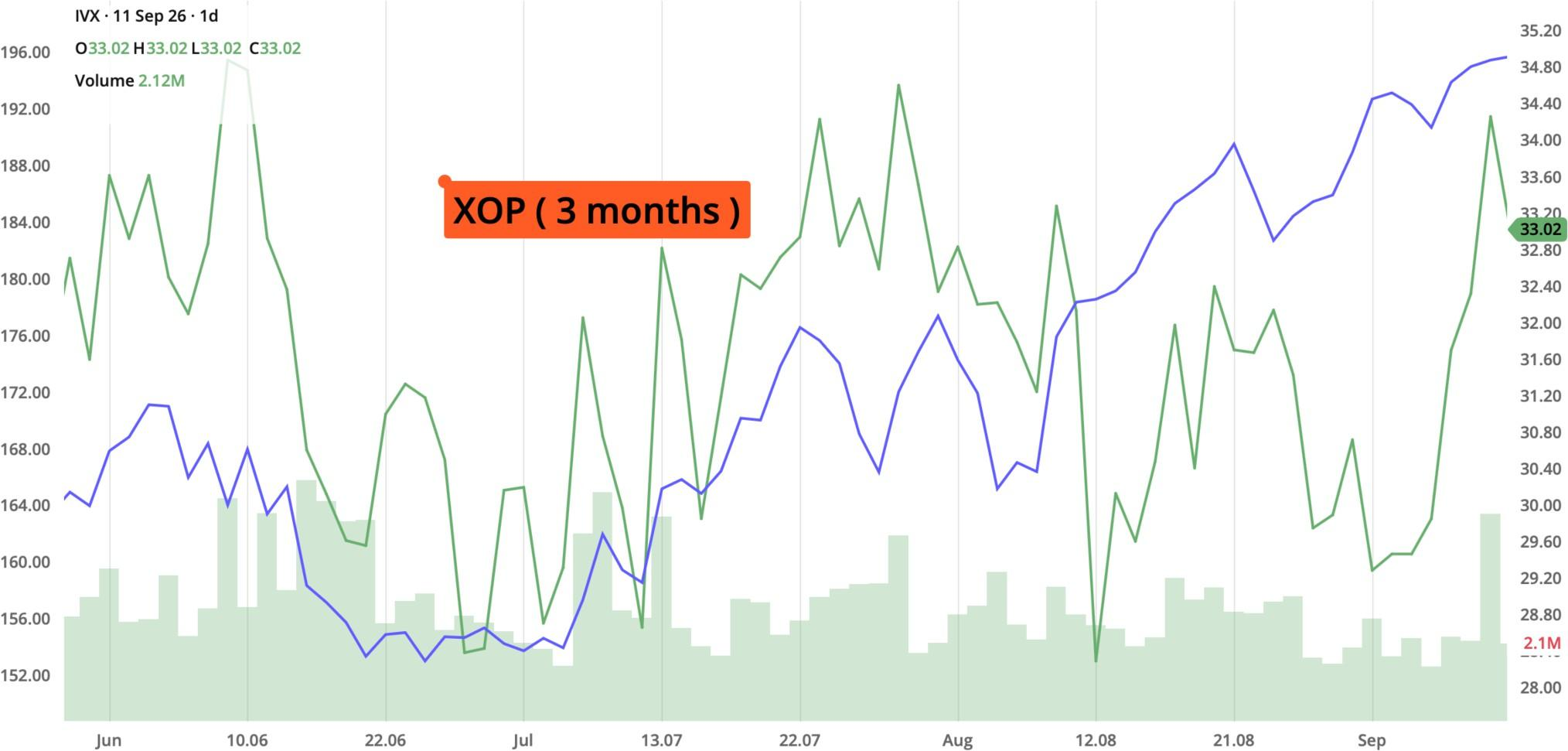
Review selected market indices below:
Daily Notable Market Action
Market Summary for Monday, Sep 7th
Equities: U.S. capital markets were closed in observance of the Labor Day holiday.
Bonds: Treasury and fixed-income markets were also closed in observance of the Labor Day holiday.
Oil: Energy futures trading was limited due to the Labor Day holiday.
Gold: Precious metals spot and futures markets experienced an extended holiday pause, with gold maintaining its safe-haven posture near recent ranges.
Digital assets: Cryptocurrencies traded through the holiday closure uninterrupted, with Bitcoin consolidating quietly in a tight corridor around $77,400–$78,500 amid light retail-driven weekend volumes.
Market Summary for Tuesday, Sep 8th
Equities: Major U.S. stock indices opened the post-holiday, shortened week on a defensive note, pressured by escalating geopolitical conflicts and surging energy costs. The DJIA dropped over 1%, while the S&P 500 and Russell 2000 finished firmly in the red. Cyclical sectors, healthcare, and financials suffered sharp selling, though energy, utilities, and select tech hardware names managed relative outperformance.
Bonds: Fixed-income markets faced heavy selling pressure, driving Treasury yields significantly higher. The benchmark 10-year Treasury yield surged to a multi-month high near 4.79% as traders aggressively repriced monetary policy expectations, factoring in a growing probability of an impending Fed rate hike.
Oil: Crude oil underwent a volatile, aggressive rally, pushing back toward triple digits. Geopolitical strikes in the Middle East and targeted drone attacks on regional energy infrastructure sparked immediate supply disruption fears, driving WTI crude up sharply to test the upper bounds of its multi-month range.
Gold: Precious metals faced a cooling session as the surging dollar-denominated cost pressures and rising Treasury yields extracted a toll. Spot gold slipped roughly 0.9% as higher real interest rates temporarily drew investment flows away from non-yielding safe-haven assets despite underlying geopolitical risks.
Digital assets: Cryptocurrencies drifted lower alongside broader risk assets. Bitcoin fell roughly 0.9%, weighed down by macro caution, rising rate-hike expectations, and localized network exploit headlines that kept altcoins under moderate pressure.
Market Summary for Wednesday, Sep 9th
Equities: U.S. stock indices extended their retreat as Wall Street digested surging energy costs and intensifying cost-push inflation fears. The S&P 500 lost approximately 0.5% and the Nasdaq faced moderate downward pressure, while small-cap and cyclical sectors underperformed significantly. Energy names bucked the trend to close higher, buoyed by surging crude, while defensive and consumer sectors faced broad institutional selling.
Bonds: Fixed-income markets remained under pressure with Treasury yields hovering near recent highs (the 10-year yield holding firm around 4.80%–4.84%) as debt-management operations and expectations of persistent monetary hawkishness kept long-duration assets pinned down.
Oil: Crude oil experienced an aggressive, headline-driven upside breakout. WTI crude jumped roughly 3% to comfortably cross above the psychological $95–$100 threshold (with Brent hitting triple digits for the first time since July) following severe Middle East supply channel escalations and reported shipping corridor disruptions.
Gold: Precious metals found renewed footing, shaking off earlier multi-session weakness. Spot and futures gold staged a steady recovery, gaining roughly 0.5%, as escalating geopolitical risks and energy inflation triggered a fresh wave of safe-haven accumulation.
Digital assets: Cryptocurrencies displayed minor chop, with Bitcoin stalling out just underneath the critical $80,000 psychological resistance boundary as market participants balanced healthy technical moving-average formations against broader macro risk aversion.
Market Summary for Thursday, Sep 10th
Equities: U.S. stock indices finished broadly lower, marking the fourth consecutive session of declines. The S&P 500 fell 0.58%, the Dow dropped 0.60%, and the Nasdaq slid 0.65%. Small caps underperformed heavily as the Russell 2000 tumbled 1.04%. Investor anxiety intensified as oil prices punched past triple digits and market participants braced for the upcoming FOMC decision and final pre-meeting inflation reads, pushing the CBOE Volatility Index (VIX) up nearly 10% to 18.04.
Bonds: Fixed-income assets experienced sharp downward pressure, pushing yields significantly higher. Driven by mounting inflation worries tied to the energy shock, the benchmark 10-year Treasury yield leaped toward the psychological 4.95%–4.96% region.
Oil: Crude oil underwent an aggressive, explosive surge, with U.S. WTI crude vaulting 7.23% to settle at $102.99 per barrel—crossing the $100 threshold for the first time since May—amid escalating concerns of a prolonged conflict disrupting Middle Eastern energy supply lines.
Gold: Precious metals faced sharp profit-taking and liquidations as the combination of surging real bond yields and aggressive dollar strength drew capital away from safe havens. Spot gold dropped 2.15% to settle near $4,365.00/oz.
Digital assets: Cryptocurrencies pulled back alongside broader risk assets. Bitcoin retreated 1.26% to test the $77,317 level, mirroring the general risk-off sentiment sweeping through traditional equity and commodity spaces.
Market Summary for Friday, Sep 11th
Equities: U.S. stock indices staged a solid end-of-week relief rally, helping trim losses from earlier in the week. Investors digested an August Consumer Price Index (CPI) report that landed largely in line with expectations (headline inflation holding at 3.4% year-over-year), alongside a modest cooling in oil prices. Mega-cap tech, selective semiconductors, and defensive names led the bounce, allowing major indices to claw back ground heading into the weekend despite the prior four-session slide.
Bonds: Fixed-income markets experienced a brief respite as Treasury yields pulled back slightly from multi-month highs. The benchmark 10-year Treasury yield drifted down modestly to settle near 4.92%–4.94% as traders paused to reassess the inflation data and position themselves ahead of the upcoming FOMC rate decision. Howard Capital Management.
Oil: Crude oil prices retreated sharply from their mid-week highs, offering much-needed relief to risk assets. WTI crude dropped over 3%, shedding roughly $3.29 to settle back below the triple-digit mark near $99.19 per barrel as profit-taking hit energy markets following days of intense geopolitical anxiety regarding the Strait of Hormuz.
Gold: Precious metals experienced a choppy session, continuing to face downward structural pressure near their 200-day moving averages. Spot gold traded near $4,404–$4,406/oz, attempting to stabilize after the prior day's sharp sell-off as sticky real yields offset traditional safe-haven demand.
Digital assets: Cryptocurrencies staged a resilient intraday recovery. After an initial knee-jerk dip toward $76,500 following the morning CPI release, Bitcoin bounced back to trade comfortably above $77,500 (gaining roughly 0.58% on the day to approximately $77,705) as institutional traders worked through the macro data uncertainties.
Notable Earnings Due for week of Sep 14th–Sep 18th
As the broader corporate earnings calendar hits a seasonally quieter stretch ahead of the third-quarter reporting season, market attention focuses on key retail, consumer discretionary, and housing bellwethers. Mid-September reports from major homebuilders and travel platforms will provide critical real-time insight into consumer demand elasticity and cost pressures under prevailing monetary conditions.
The actual earnings date may vary, so traders should confirm with their brokers. If a trader wishes to open a position to participate in earnings announcements, it is important to check whether the earnings are released BEFORE the markets open or AFTER the markets close on the date of earnings.
Mon, Sep 14th: HAIN / HITI / HYFT / PLAY
Tue, Sep 15th: FPS / TCOM / VRA
Wedn, Sep 16th: LEN / LUXE
Thu, Sep 17th: no reports scheduled from major tier-1 companies
Fri, Sep 18th: no reports scheduled from major tier-1 companies
Economic Calendar Due for week of Sep 14th–Sep 18th
Following a week dominated by inflation prints and market cross-currents, the macroeconomic focus shifts entirely toward central bank policy decisions, key consumer health updates, and major global monetary updates. Highlighting the mid-September schedule is the highly anticipated Federal Reserve interest rate decision, alongside critical retail sales figures and international central bank meetings that will test global market resilience.
Monday, September 14th:
- Canada Consumer Price Index (CPI): A vital early-week read on retail inflation trends north of the border, providing immediate direction for the Bank of Canada's upcoming monetary policy path.
Tuesday, September 15th:
- U.S. Retail Sales (Advance Report): A crucial high-impact gauge of American consumer spending momentum across retail sectors, offering clear visibility into whether consumer resilience is holding up against macroeconomic headwinds.
- U.S. Industrial Production & Capacity Utilization: Key metrics measuring the output of U.S. factories, mines, and utilities, tracking manufacturing sector health and broader industrial momentum.
Wednesday, September 16th:
- FOMC Rate Decision & Economic Projections: The marquee event of the week. The Federal Reserve announces its latest interest rate decision, accompanied by the updated Summary of Economic Projections (SEP) and Chair Powell's press conference, setting the tone for global liquidity and asset pricing.
Thursday, September 17th:
- Bank of England (BoE) Rate Decision: Following the Fed's lead, the central bank delivers its policy verdict alongside domestic inflation data, shaping cross-currency dynamics for the British pound.
- U.S. Weekly Initial & Continuing Jobless Claims: Standard high-frequency updates on labor market friction and initial unemployment filings.
Friday, September 18th:
- Bank of Japan (BoJ) Interest Rate Decision: Concluding a heavy central bank policy week, the BoJ updates its policy rate and balance sheet guidance, impacting global bond yields and carry-trade positioning.
Blue Sky Horizons
The Commercial Orbital Economy & LEO Infrastructure (Part 2)
As low Earth orbit transitions decisively from an institutional testbed into a bustling commercial marketplace, the structural architecture supporting the orbital economy is scaling up at an unprecedented pace. Building upon last week's exploration of early station design, Part 2 examines the convergence of private capital, next-generation cargo return capabilities, and edge-computing constellations that are redefining the space tech ecosystem.
- Commercial Stations & The Post-ISS Transition: The race to establish private human habitats in LEO is entering a critical execution window. Private entities are moving past initial conceptual phases to finalize structural assembly timelines. Platforms like Vast's Haven-1, Axiom Space's modular station architecture, and the Starlab initiative are laying the groundwork to prevent any crewed orbital gap ahead of the International Space Station's planned retirement. These stations are engineered from the ground up to support commercial microgravity research, pharmaceutical manufacturing, and private astronaut tourism.
- Autonomous Cargo & Sovereign Logistics: Independence in space logistics is becoming a core strategic pillar for international space agencies. Recent landmark service contracts—such as the European Space Agency's backing of autonomous cargo return capabilities (via programs like ALADDIN)—underscore a major shift in industrial models. Public agencies are increasingly acting as institutional anchor customers while private ventures secure substantial independent financing, driving down payload costs and accelerating flight-test cadences.
- Orbital Edge Computing & Constellation Scaling: LEO infrastructure is no longer solely about basic connectivity or Earth observation; it is rapidly morphing into an active compute layer. Recent billion-dollar deployments integrating onboard artificial intelligence models directly into satellite buses are establishing an orbital edge-computing architecture. These systems allow real-time data processing in space for defense, civil, and commercial applications, drastically reducing latency and reliance on down-link bandwidth.
For self-directed investors and long-term capital allocators, the maturation of the commercial LEO economy shifts the space sector out of pure "speculative venture" territory and into an emerging industrial asset class. Analyzing this space through an institutional investment framework reveals three critical themes:
- The Shift from Capex-Heavy Pioneers to Infrastructure Toll-Roads: Early-stage space investing was defined by high-burn rocket manufacturing and speculative launch providers. Today, capital is migrating toward infrastructure "toll-roads"—companies providing essential services such as orbital debris tracking, space-based data routing, LEO logistics, and microgravity manufacturing platforms. These businesses offer recurring-revenue models rather than one-off hardware sales.
- Dual-Use Commercial and Defense Moats: The convergence of commercial utility and national security makes aerospace and orbital infrastructure uniquely resilient. With government defense budgets increasingly integrating commercial satellite constellations and rapid-response logistics, companies securing government anchor-tenancy agreements offer investors a high-visibility revenue floor coupled with private-sector growth upside.
- Portfolio Diversification via Non-Correlated Assets: As terrestrial markets face cyclical pressures, macro headwinds, and debt-sustainability debates, pure-play space infrastructure investments represent a structural growth theme largely decoupled from traditional consumer or real estate cycles. However, allocators must carefully weigh regulatory hurdles, spectrum allocation risks, and high capital-expenditure cycles when sizing long-term positions.
For market participants tracking the commercial space and orbital infrastructure value chain, several publicly traded companies span key sub-sectors:
- Launch Providers & Heavy Transport:
- Rocket Lab USA, Inc. (NASDAQ: RKLB): A prominent player in small-to-medium-class launch services and space systems, providing end-to-end spacecraft components, satellite manufacturing, and on-orbit management solutions.
- Commercial Stations & Orbital Infrastructure:
- Voyager Technologies, Inc. (NYSE: VOYG): Involved in defense and national security space solutions, and a majority partner in the Starlab joint venture developing a commercial space station platform.
- Redwire Corporation (NYSE: RDW): A key industrial enabler focusing on mission-critical space solutions, deployable structures, solar arrays, and in-space manufacturing/3D printing capabilities.
- Satellite Manufacturing & Subsystems:
- MDA Space Ltd. (TSX: MDA): A major space-robotics and software-defined satellite manufacturer building advanced LEO constellation architecture and robotic automation systems.
- Direct-to-Device Connectivity & Earth Observation:
- AST SpaceMobile, Inc. (NASDAQ: ASTS): Building a space-based cellular broadband network designed to connect directly to standard, unmodified mobile phones via LEO.
- Planet Labs PBC (NYSE: PL): Operates a massive fleet of Earth observation satellites providing high-frequency geospatial data and analytics.
The Takeaway: The commercial orbital economy is decoupling from pure government dependency. By looking past short-term media hype and focusing on cash-flowing B2B enablers, disciplined investors can identify the structural utility providers of the 21st-century cosmic economy.
Thank you for reading. Until next week's close,
Have a safe and productive Trading week!
Fauzia Timberlake
About the Author: Fauzia Timberlake is a professional options coach and financial strategist specializing in risk management and portfolio architecture for self-directed investors. She is Founder and Managing Partner of Option Engines.
Questions / Comments
We're here to serve IVolatility users and we welcome your questions or feedback about the option strategies discussed in this newsletter. If there is something you would like us to consider and/or analyze, we're always open to your suggestions. Use support@ivolatility.com.
Previous issues are located under the Trade Ideas tab on our website.