Fed Tightening and the Tech-Defensive Tug-Of-War
By Fauzia Timberlake, personal coach for trading options
September 21, 2026
Macro Overview of Markets
The defining catalyst of the week was the convergence of a hawkish Federal Reserve rate decision and the 10-year Treasury yield crossing the 5.00% threshold. The week of September 14th through September 18th, 2026, delivered a high-stakes tug-of-war across global asset classes. With macroeconomic pressures tightening financial conditions, capital rotated sharply across growth, defensives, and hard assets.
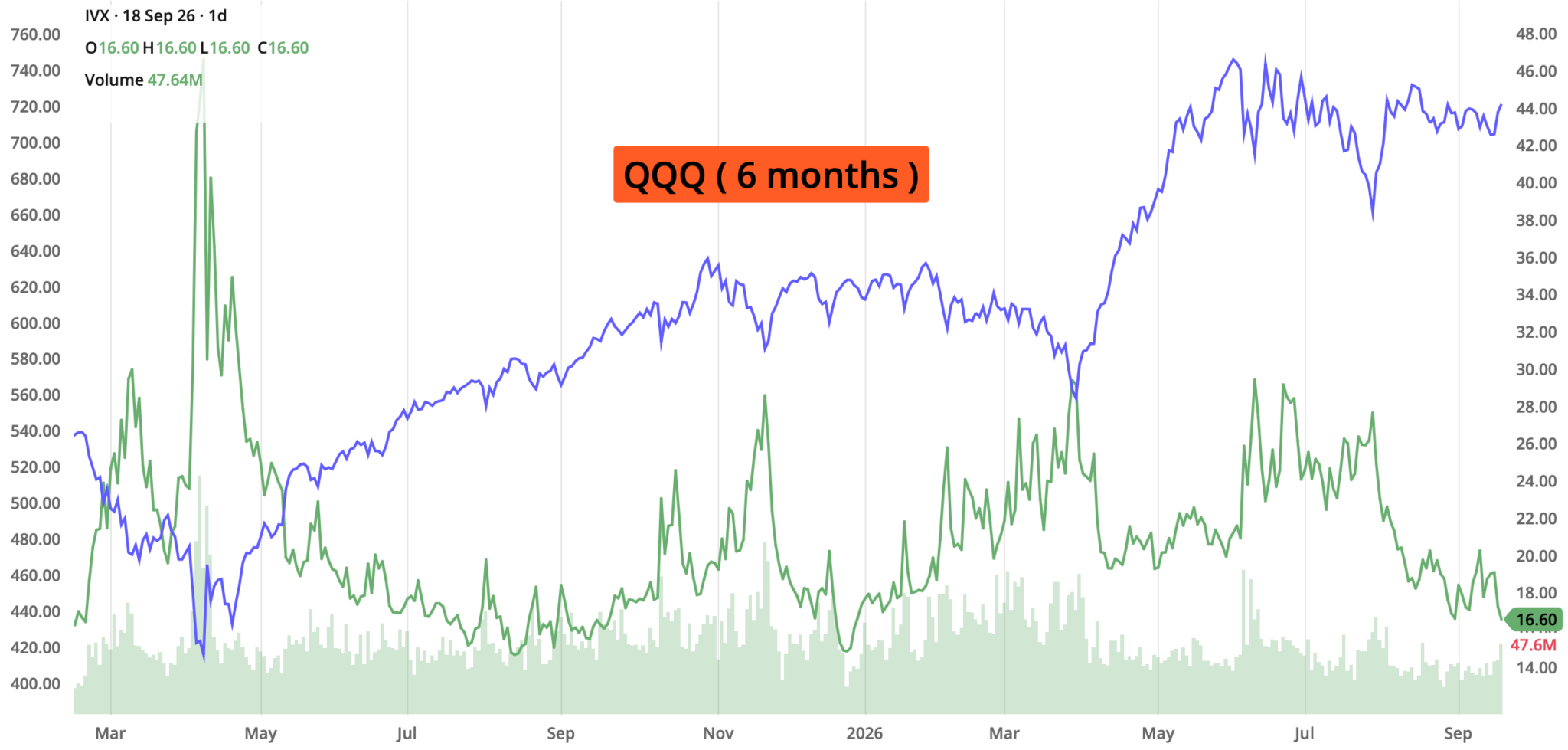
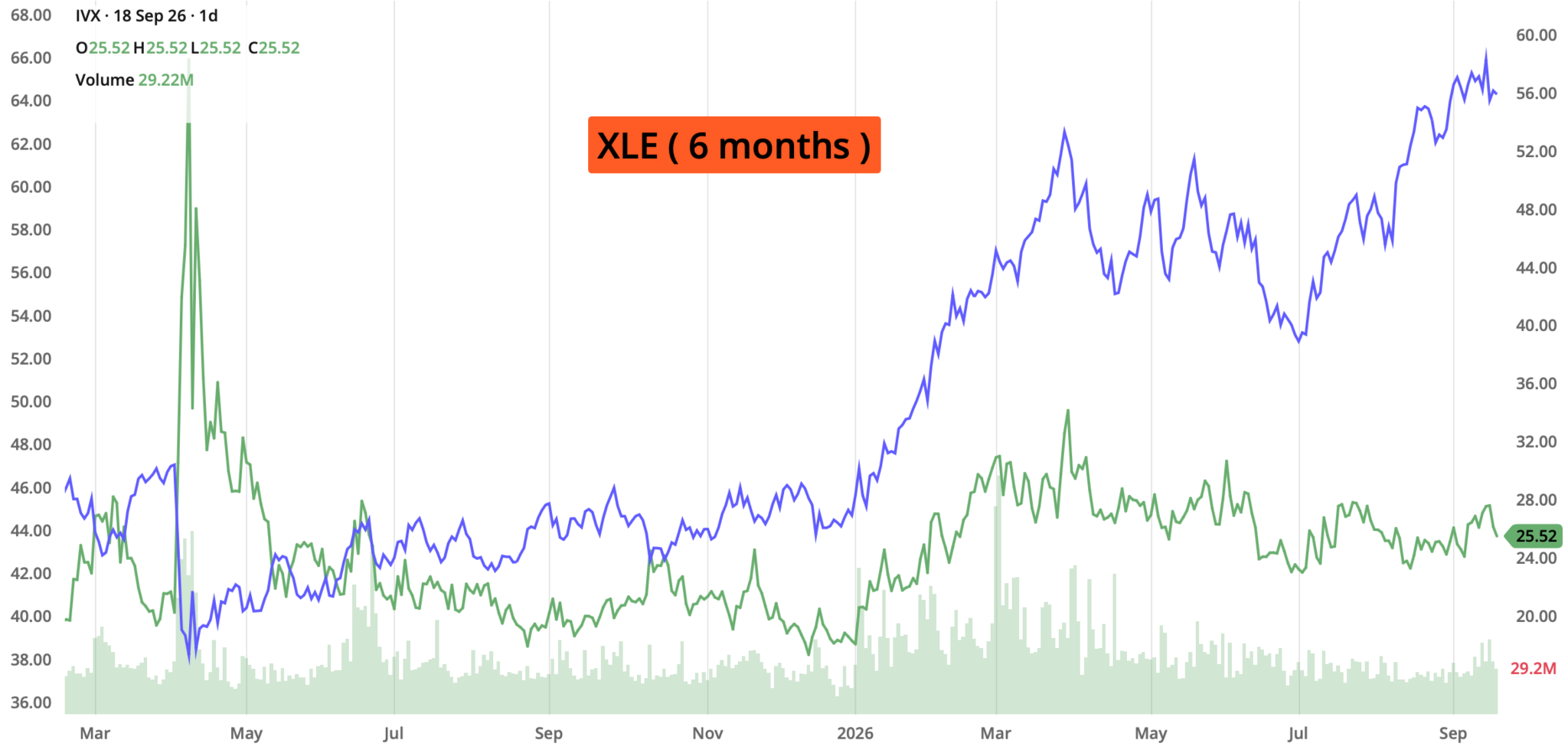
Equity markets experienced a pronounced divergence between growth leadership and cyclical/rate-sensitive lag. While the broader S&P 500 managed a modest gain (+0.35%) and the QQQ rallied +2.58% on resilient tech strength, broader small-cap and blue-chip indexes felt the strain. The Dow Jones Industrial Average dropped –1.65% and the Russell 2000 slipped –1.18%. Sector action underscored this internal crosscurrent: consumer discretionary (+2.37%), consumer staples (+1.05%), and healthcare (+0.64%) attracted inflows, whereas rate-sensitive sectors like real estate (–2.00%), energy (–2.00%), and financials (–1.44%) faced persistent selling pressure.
Fixed-income markets bore the brunt of hawkish monetary policy updates. The benchmark 10-year U.S. Treasury yield rose by +4.7 basis points to close at 5.008% (+0.95% for the yield itself), decisively crossing the psychological 5.00% threshold. The upward pressure on yields reflected aggressive re-pricing of terminal rate expectations and tightening liquidity conditions following the Fed's hawkish policy shift.
Crude oil prices pulled back over the week as early-week geopolitical supply jitters gave way to broader macroeconomic demand concerns. West Texas Intermediate (WTI) front-month futures slid from early-week highs around $102.42 to settle at $100.30 per barrel, marking a weekly loss of -2.07%.
Gold served as a premier safe-haven beneficiary amid surging yields and policy uncertainty. GLD advanced +2.37%, outperforming traditional cyclical commodities as investors hedged against currency devaluation risks and tightening financial conditions.
Digital assets displayed notable resilience, decoupling from traditional risk-off equities mid-week. BTC/USD climbed from an opening baseline near $76,813 to break back above the $80,000 threshold, finishing the week at approximately $80,891 for a robust gain of +5.31%.
Strategy Corner
Based on this week's market movements, here are some trading ideas and option strategies for the readers' consideration. The positions can be scaled bigger (or smaller) to suit individual account size.
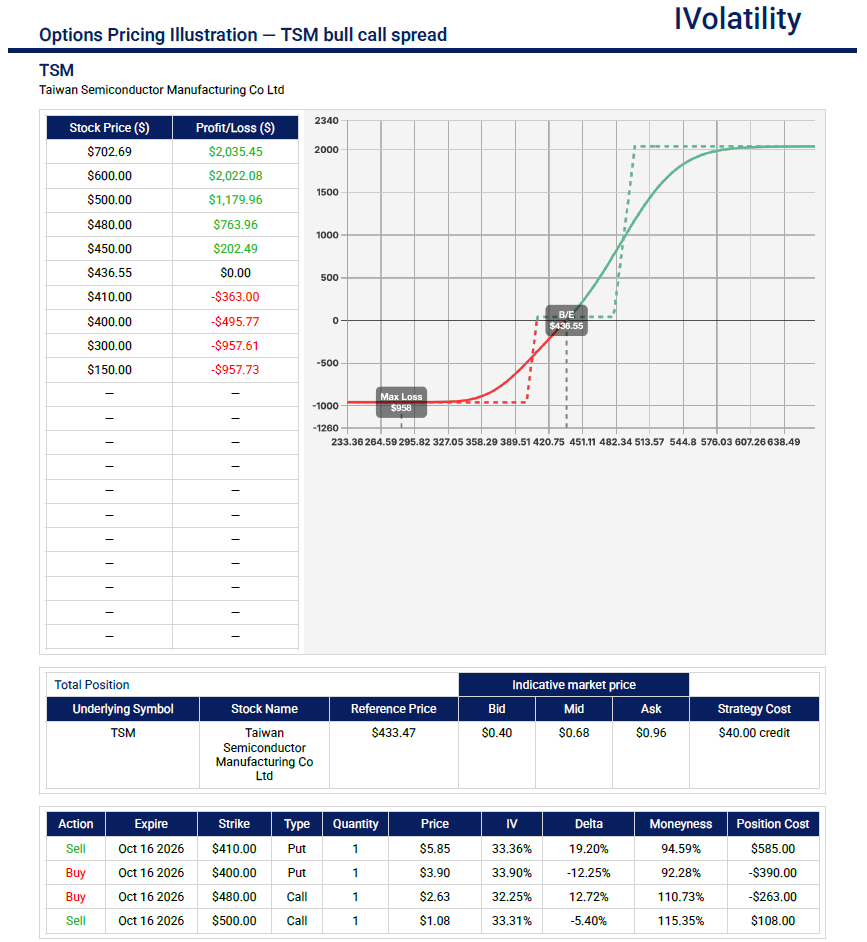
TSM (closed around 434.03 on Friday, Sep 18th)
High-performance computing (HPC) and relentless global demand for advanced AI accelerators continue to drive dominant volume growth, giving the stock robust fundamental momentum heading into the back half of Q3 and early Q4. If a trader would like to get bullish, a position such as described below could be employed.
- Structure: In the Oct monthly expiration, buy the OTM 480/500 long call spread and finance it with the purchase of the 400/410 put spread.
- Credit collected: small, but enough to cover the cost of the long call spread
- Downside breakeven around 400; no risk to the upside
- Max potential profit of $2000 if TSM expires above 500 at expiration
META (closed at 665.48 on Friday, Sep 18th)
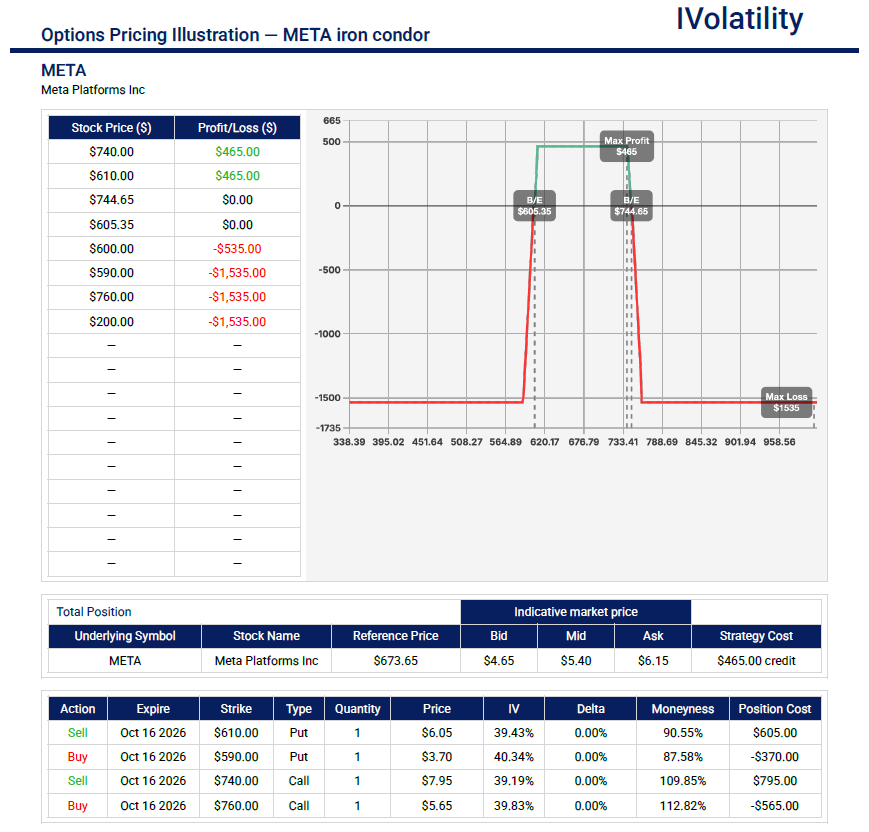
META has experienced a strong upward move over the past month, trading around the $665 to $673 range. Market structure data highlights a heavy supply wall near $675, a key historical resistance level where the stock has faced multiple rejections year-to-date. This ceiling caps immediate runaway upside momentum in the short-to-intermediate term.
If a trader would like to be neutral through the October expiration, selling an iron condor on META could be an effective way to monetize high options premium while maintaining a strictly neutral stance.
- Structure: In the Oct monthly expiration, sell the 590/610/740/760 iron condor.
- Credit collected:
- Downside breakeven around 400; no risk to the upside
- Max potential profit of $2000 if TSM expires above 500 at expiration
Movement of the Major Market Indices:
| INDEX | UP | DOWN |
| SPY | 0.35% | |
| QQQ | 2.58% | |
| IWM | -1.18% | |
| DIA | -1.65% | |
| GLD | 2.37% | |
| BTC/USD | 5.31% | |
| 10-year yield | 0.95% | |
| Crude Oil | -2.07% | |
| VIX | -15.37% |
Movement of the Major Market Sectors:
| SECTOR | UP | DOWN |
| TECH (XLK) | -0.39% | |
| FINANCIALS (XL) | -1.44% | |
| INDUSTRIALS (XLI) | -1.26% | |
| ENERGY XLE | -2.00% | |
| HEALTHCARE (XLV) | 0.64% | |
| UTILITIES (XLU) | -1.40% | |
| MATERIALS (XLB) | -1.37% | |
| REAL ESTATE (XLRE) | -2.00% | |
| CONSUMER STAPLES (XLP) | 1.05% | |
| CONSUMER DISCRETIONARY (XLY) | 2.37% |
Notable Gainers Week of Sep 14th – Sep 18th
The notable gainers for the week of September 14th–18th were heavily defined by a late-week macro rebound. After early-week selling pressure driven by surging crude oil prices and spiking Treasury yields (with the 10-year yield touching 5.00%), markets caught a strong tailwind. This reversal was powered by in-line consumer inflation (CPI) prints, an easing of acute geopolitical supply premiums in energy markets, and major regulatory and structural breakthroughs within digital assets, software, and enterprise infrastructure.
Coinbase Global (COIN) gained approximately +9.2% (anchored by strong early-week momentum). The surge followed the SEC's issuance of a conditional five-year "Innovation Exemption," which authorized eligible platforms to trade tokenized versions of U.S.-listed equities without traditional exchange registration.
Robinhood Markets (HOOD) gained approximately 8.5% (pushing the stock cleanly past the $120 threshold). The gain was in tandem with broader digital asset and retail brokerage momentum, benefiting directly from the same regulatory tailwinds and heightened platform activity.
Strategy Inc. (MSTR) gained almost 7% (recovering sharply during the late-week macro risk-on rotation). MSTR outperformed alongside crypto-linked equities and digital asset proxies as market participants rotated back into high-beta risk and treasury-backed digital asset strategies.
Sandisk (SNDK) gained approximately 7.4% with the strong advance due to robust momentum for AI data-center storage demand, combined with pre-announcement positioning ahead of its scheduled index inclusion.
Hewlett Packard Enterprise (HPE) jumped almost 6%. The sharp late-week rally was driven by strong institutional demand for enterprise-grade hybrid cloud infrastructure and high-performance computing (HPC) solutions as broader market risk appetite returned.
Dell Technologies (DELL) rose over 6%, rebounding firmly past $588 by late week following a brief Monday dip. The advance was mainly due to robust corporate procurement cycles for AI-optimized PowerEdge servers and resilient enterprise infrastructure bookings.
Notable Losers Week of Sep 14th – Sep 18th
The notable losers for the week of September 14th–18th were heavily pressured by a combination of surging macroeconomic yields—with the 10-year U.S. Treasury yield pressing at or above the crucial 5.00% threshold—and acute sector-specific headwinds. Discretionary consumer names suffered from tightening household financial cushions, select high-beta segments faced valuation compression following early-week AI infrastructure scrutiny, and specific industrial/automotive operators pulled back sharply amid supply and demand adjustments.
Ionis Pharmaceuticals (IONS) lost about 18% due mostly to sharp profit-taking and sentiment pullback across biotech holdings, making it one of the week's steepest large-cap decliners amidst broader defensive sector rotations.
AutoNation (AN) dropped over 17% alongside cyclical automotive retail weakness as high interest rates weighed heavily on consumer financing and big-ticket vehicle demand.
Sonic Automotive (SAH) shed over 16% primarily in tandem with automotive dealership peers, pressured by margin compression concerns and surging borrowing costs impacting consumer vehicle affordability.
Shake Shack (SHAK) lost almost 14%. The pronounced downward momentum occurred as consumer discretionary and fast-casual dining stocks faced broad institutional selling amid tighter consumer wallet tracking.
J.B. Hunt Transport Services (JBHT) dropped over 13%. The sharp decline was mostly following softer domestic freight volume indicators and rising operational cost pressures across the logistics and transportation sector.
Review selected market indices below:
Daily Notable Market Action
Market Summary for Monday, Sep 14th
Equities: Major U.S. indices opened the week on a defensive note, pressured by escalating geopolitical tensions and surging energy costs. The Dow Jones dropped over 1%, while the S&P 500 and Russell 2000 finished firmly in the red. Cyclical sectors, financials, and healthcare experienced heavy selling, though utilities and select tech hardware demonstrated relative resilience.
Bonds: Fixed-income markets faced intense selling pressure, pushing the benchmark 10-year Treasury yield up toward multi-month highs as traders aggressively repriced monetary policy expectations.
Oil: Crude oil underwent a volatile, aggressive rally, pushing back toward triple digits amid supply and transit fears.
Gold: Spot gold slipped roughly 0.9% as surging dollar-denominated costs and rising real yields drew investment flows away from non-yielding safe havens.
Digital assets: Bitcoin drifted lower by roughly 0.9%, weighed down by macro risk aversion and rising rate-hike expectations.
Market Summary for Tuesday, Sep 15th
Equities: Stocks remained under pressure in a choppy session, with the market exhibiting extreme selectivity as investors navigated elevated crude prices hovering near $97–$98 and growing fears of tighter monetary conditions.
Bonds: Treasury yields continued their upward march, with the 10-year yield pressing closer to the psychological 5% threshold, tightening financial conditions further across rate-sensitive asset classes.
Oil: Crude oil consolidated near recent highs, maintaining severe pressure on transport and manufacturing cost inputs.
Gold: Precious metals found renewed footing, staging a steady recovery (gaining roughly 0.5%) as persistent geopolitical risks and energy inflation triggered fresh safe-haven accumulation.
Digital assets: Cryptocurrencies displayed minor chop, with Bitcoin stalling out just underneath the critical $80,000 psychological resistance boundary.
Market Summary for Wednesday, Sep 16th
Equities: Stocks experienced intense, headline-driven volatility surrounding the Federal Reserve's policy decision. Equities were initially green into the afternoon, but sold off sharply after the Fed delivered a "hawkish hike" (a unanimous quarter-point increase to 3.75%-4% alongside projections signaling an additional hike ahead). The S&P 500 fell 0.45% and bank stocks took heavy losses.
Bonds: Yields spiked significantly following the hawkish dot plot; the benchmark 10-year Treasury yield officially broke back above 5% to finish near 5.01% (its highest level since 2007), while the 2-year yield climbed to 4.72%.
Oil: Crude oil pulled back slightly from its intraday highs, offering brief pre-announcement relief before settling near elevated ranges.
Gold: Spot gold rose roughly 0.88%, benefiting strongly from its dual role as a safe-haven and inflation hedge as the 10-year yield pinned above 5%.
Digital assets: Bitcoin traded lower by about 1.4%, reacting as a high-beta risk asset alongside the broader post-Fed equity pullback.
Market Summary for Thursday, Sep 17th
Equities: Wall Street executed a strong "buy-the-dip" rebound as the primary catalysts of the previous day's sell-off relented. The Nasdaq led the charge by jumping 1.69% as rate-sensitive tech bounced hard, while the S&P 500 advanced 1.14% and the Dow added 316 points. Financials lagged behind, reflecting lingering caution over high interest rates.
Bonds: Treasury yields eased off their 2007 highs, snapping an eight-day rising streak as traders trimmed expectations of an aggressive near-term follow-up hike, though the 10-year remained pinned near the 5% threshold.
Oil: WTI crude slipped back under $101 per barrel following reports that Saudi Arabia routed extra supply through Oman and accelerated pipeline restarts, alleviating immediate supply panic.
Gold: Gold firmed near recent highs, maintaining its safe-haven bid amidst ongoing geopolitical friction and a still-live inflation backdrop.
Digital assets: Bitcoin stabilized alongside the broader risk-on macro bounce, though upside momentum remained constrained.
Market Summary for Friday, Sep 18th
Equities: Markets closed out a frenetic week with a more cautious, consolidated posture as participants weighed the long-term implications of a 5% 10-year yield against resilient mega-cap technology strength.
Bonds: Fixed-income markets steadied heading into the weekend, with the 10-year Treasury yield consolidating just around the psychological 5.00% marker.
Oil: Energy markets hovered near mid-week lows (~$101) as supply-route headlines neutralized acute geopolitical fear premiums.
Gold: Precious metals retained solid weekly gains, closing near the upper end of their range as institutional investors held safe-haven allocations.
Digital assets: Cryptocurrencies drifted sideways in a tight consolidation corridor, mirroring the late-week stabilization across traditional risk assets.
Notable Earnings Due for week of Sep 21st–Sep 25th
Following a period dominated by macro policy shifts and broad market re-pricing, the corporate earnings calendar shifts toward mid-tier retail, specialized business services, and consumer staples bellwethers. While large-cap tech reporting remains relatively quiet, upcoming operational updates from key retail and industrial operators will provide a direct read on consumer wallet health and supply chain margins heading into the final stretch of the third quarter.
The actual earnings date may vary, so traders should confirm with their brokers. If a trader wishes to open a position to participate in earnings announcements, it is important to check whether the earnings are released BEFORE the markets open or AFTER the markets close on the date of earnings.
Mon, Sep 21st: no notable earnings announcements expected
Tue, Sep 22nd: AZO
Wedn, Sep 23rd: CTAS / GIS
Thu, Sep 24th: COST / DRI
Fri, Sep 25th: no notable earnings announcements expected
Economic Calendar Due for week of Sep 21st–Sep 25th
Following a week defined by shifting bond yields and persistent energy price headwinds, the macroeconomic focus pivots decisively toward major central bank policy decisions and vital consumer health indicators. Highlighting the mid-September calendar is the marquee Federal Reserve interest rate decision alongside updated economic projections, complemented by critical domestic retail sales figures and high-stakes international central bank meetings.
Monday, September 21st:
- China Loan Prime Rate (LPR) fixing
Changes or holds in China's benchmark lending rates dictate liquidity conditions for the world's second-largest economy, directly moving Asian equity benchmarks, industrial metals, and currency pairs tied to global growth (such as the AUD).
Tuesday, September 22nd:
- U.S. Weekly ADP Employment Change data
This high-frequency read on private-sector hiring provides an early directional pulse on domestic labor market health, influencing Treasury yields and rate-cut expectations ahead of official government employment figures. - Global Central Bank Commentary
Coordinated commentary from major central bank leaders helps anchor market expectations regarding the pace of global monetary easing or tightening, injecting intraday volatility into equity and forex markets.
Wednesday, September 23rd:
- Global Flash S&P Global PMIs
As leading economic indicators, preliminary Purchasing Managers' Index reports offer the earliest monthly snapshot of manufacturing and services health, heavily driving risk sentiment, currency flows, and bond valuations globally.
Thursday, September 24th:
- Global Central Bank Rate Decisions
A heavily packed international monetary policy day that sets borrowing costs across Europe and emerging markets, triggering sharp cross-asset adjustments in European equities and regional currencies. - U.S. Initial Jobless Claims
Serving as the most timely weekly gauge of domestic labor market cooling or resilience, higher- or lower-than-expected claims directly impact fixed-income pricing and Federal Reserve policy bets.
Friday, September 25th:
- U.S. Durable Goods Orders (August Preliminary)
This report measures new orders placed with domestic manufacturers for long-lasting goods, providing a vital gauge of underlying business investment and industrial sector health.
Blue Sky Horizons
The Next-Gen Quantum Computing Frontier
While artificial intelligence handles classical computational scaling, the race to achieve true quantum utility is quietly reaching an inflection point. Major breakthroughs in fault tolerance, error correction, and silicon-spin qubit integration are transitioning quantum systems from isolated laboratory experiments into commercially viable infrastructure designed to solve complex optimization, cryptography, and molecular modeling problems that classical supercomputers cannot touch.
- The Fault-Tolerant Quantum Inflection Point: The technological narrative is rapidly expanding beyond classical AI acceleration as quantum computing research crosses critical error-correction thresholds. By moving away from noisy intermediate-scale quantum (NISQ) systems and toward fault-tolerant architectures, developers are successfully demonstrating stable logical qubits that drastically reduce decoherence errors and maintain computational integrity over extended durations.
- Real-World Commercial Applications & Complex Optimization: As physical hardware matures, commercial focus is shifting firmly toward practical optimization use cases. Industries ranging from pharmaceutical molecular discovery and advanced material science to complex financial portfolio risk modeling and global supply chain logistics are actively prototyping hybrid classical-quantum algorithms to solve intractable computational problems.
- Cryptographic Shifts & Post-Quantum Security: The rapid advancement of processing capabilities is forcing an urgent parallel transformation in cybersecurity. Enterprise security protocols and financial institutions are accelerating their migration toward post-quantum cryptography (PQC) standards to preempt future decryption vulnerabilities and safeguard critical digital infrastructure.
- Specialized Supply Chain & Ecosystem Convergence: Building, housing, and maintaining ultra-cooled, dilution-refrigerator-based quantum infrastructure demands a deeply specialized supply chain. From cryogenic components and microwave electronics to hyper-pure isotopic materials, this high-barrier-to-entry ecosystem highlights the foundational tech suppliers laying the groundwork for the next generational leap in global processing power.
The Takeaway: For self-directed investors tracking this frontier, exposure extends across a distinct spectrum of industry leaders: tech giants like IBM and
Thank you for reading. Until next week's close,
Have a safe and productive Trading week!
Fauzia Timberlake
About the Author: Fauzia Timberlake is a professional options coach and financial strategist specializing in risk management and portfolio architecture for self-directed investors. She is Founder and Managing Partner of Option Engines.
Questions / Comments
We're here to serve IVolatility users and we welcome your questions or feedback about the option strategies discussed in this newsletter. If there is something you would like us to consider and/or analyze, we're always open to your suggestions. Use support@ivolatility.com.
Previous issues are located under the Trade Ideas tab on our website.